

What’s the 3 Second Rule on TikTok?
TikTok is a speed test. Not for your Wi-Fi. For your story.
People open the app with one finger already in motion. They’re not “watching.” They’re scanning. Your video gets a tiny trial window where the viewer decides—almost without thinking—stay or swipe. That’s the scroll-or-stay reality. And it’s brutal.
The 3-second rule is the name creators give to that first micro-moment: you have about three seconds to earn attention before the viewer leaves. It’s not just about being flashy. It’s about being instantly clear. Clear value. Clear intrigue. Clear payoff.
In this guide, you’ll learn:
- what the 3-second rule actually is (and why it matters)
- how TikTok’s algorithm reads those first seconds
- what changed in 2025 with new retention checkpoints (so you don’t stop at the hook)
- practical hook tactics you can use today—without changing your niche
Here’s the promise, straight: “If you fix the first 3 seconds, you fix everything downstream.”
Because the first 3 seconds decide whether you get watch time. Watch time decides whether TikTok tests your video on more people. And that decides whether you get reach—or a quiet post that dies in your drafts folder’s shadow.
We’ll prove it with simple logic and usable structures. No mysticism. No “just be more engaging.” Just what works when attention is the currency and three seconds is the toll booth.
1) The 3-Second Rule, Defined
1.1 What it actually means
The 3-second rule is simple: you have roughly three seconds to earn attention before most people scroll.
In that tiny window, viewers make an almost instant call—stay or swipe—based on what they see, hear, and understand immediately.
1.2 Why “3 seconds” isn’t just a vibe
Three seconds matters because it’s not only psychological—it’s mechanical.
On TikTok, a watch that reaches the 3-second mark is counted as a view, and that early retention becomes a signal that helps TikTok decide whether your video is engaging enough to test on more people.
If lots of viewers drop before three seconds, distribution typically tightens. If they stay, your video gets a better chance at wider reach—because the platform has evidence it can hold attention.
2) Why the 3-Second Rule Matters for the TikTok Algorithm
2.1 The “audition” model (how distribution expands)
Think of TikTok like a series of auditions, not one big premiere.
Your video gets shown to a small test group first. If those people stick around past the early moments (especially the first 3 seconds), TikTok “books” you for a bigger room: a larger test group. If retention holds again, the platform keeps widening the audience—until you’re landing on the FYP at scale.
2.2 What the algorithm rewards most
TikTok doesn’t start by asking “Is this creator popular?” It starts by asking: Do people actually watch this?
The platform uses multiple ranking signals (interactions, video info, user context), but the strongest performance driver is still watch time and retention—how long people stay, whether they finish, whether they rewatch.
Likes and comments can help, but they’re not the core engine. Retention is. Because retention is proof: the content held attention, not just a thumb-tap.
3) The 2025 Algorithm Reality: Retention Has Multiple Checkpoints
3.1 The new retention checkpoints (and what they mean)
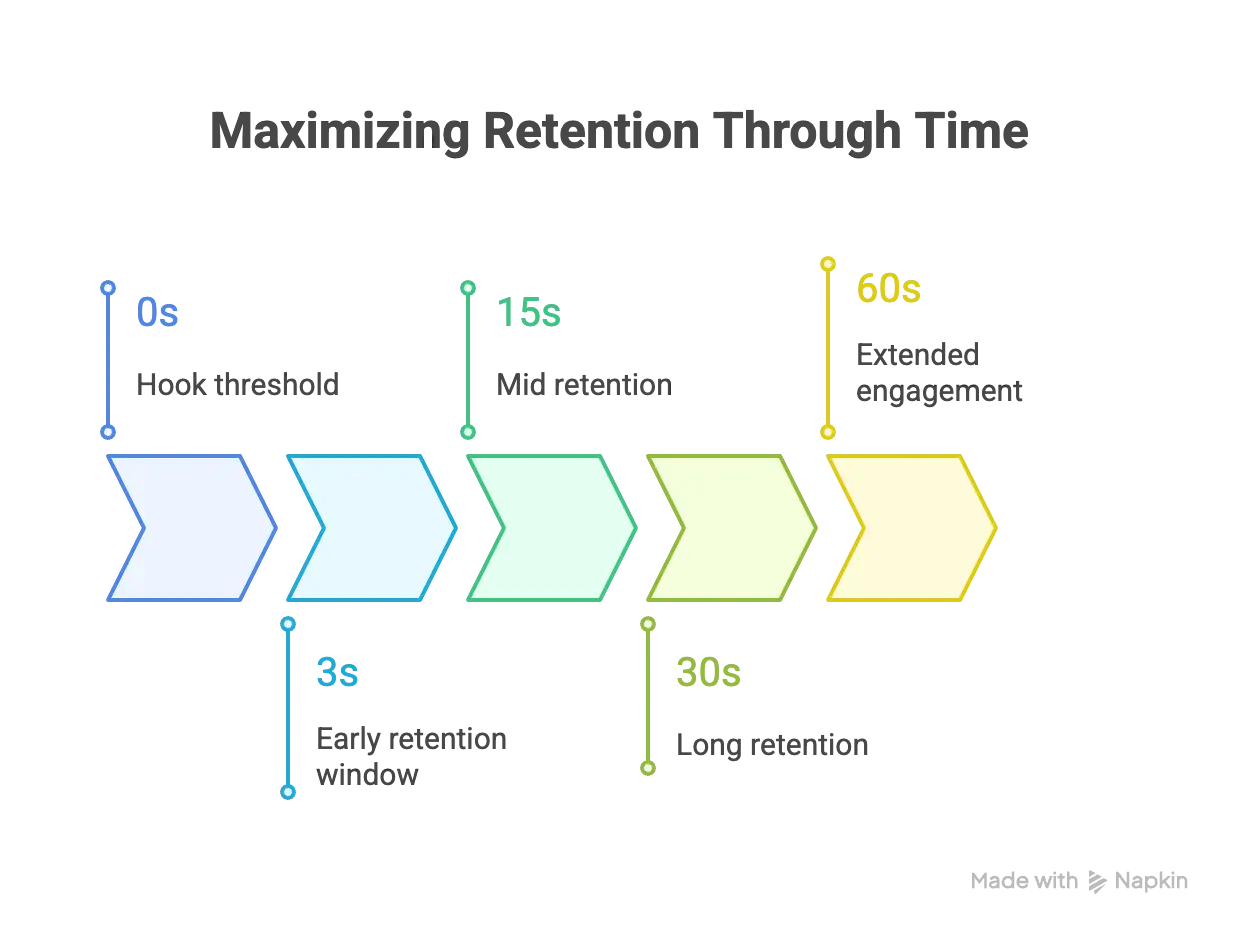
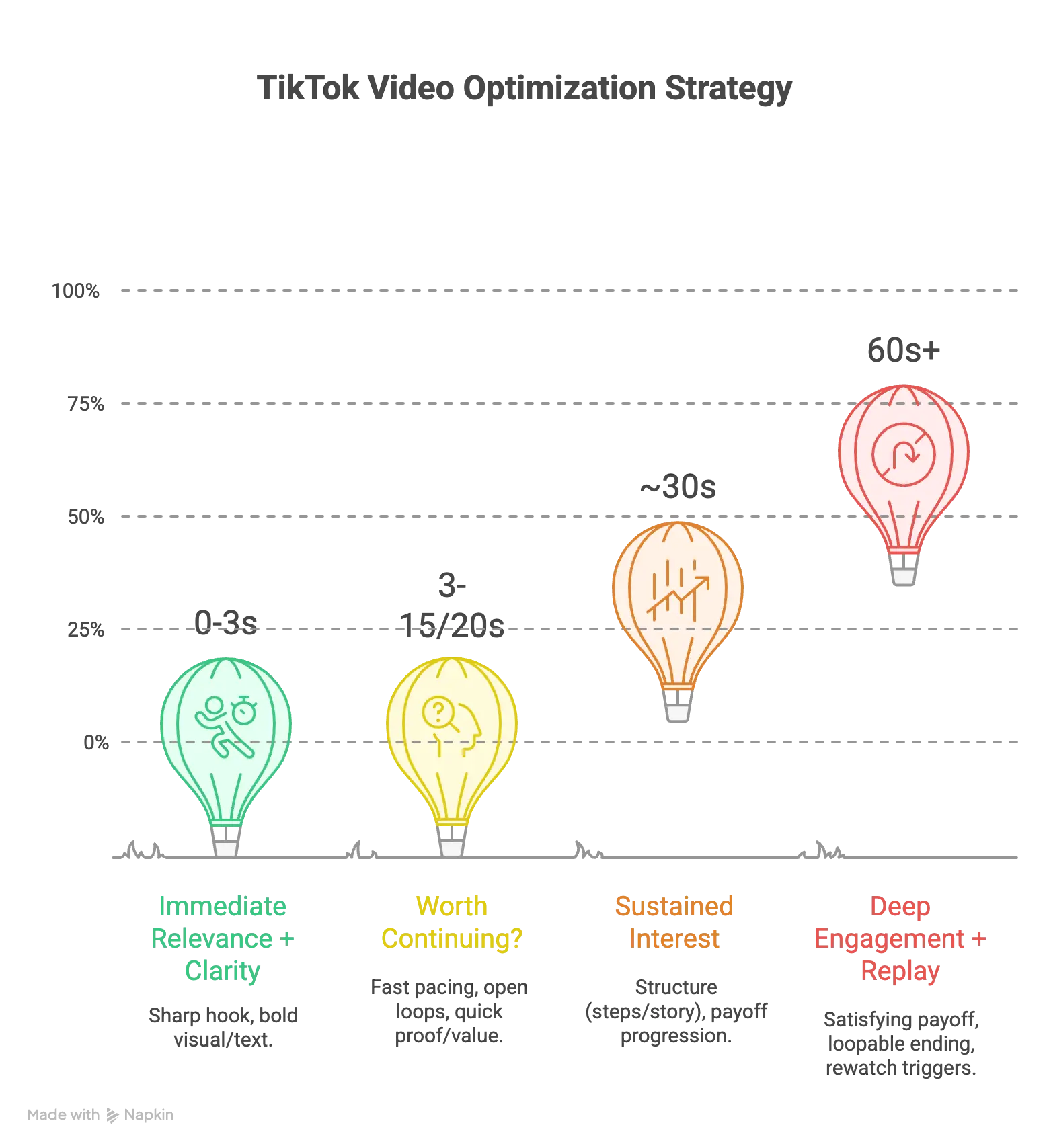
In 2025, TikTok is paying attention in stages, not just at the start. The key checkpoints being discussed are:
- 3 seconds: view threshold + first filter
- 15–20 seconds: a newer “make-or-break” window where TikTok evaluates whether the video has real legs
- 30 seconds: mid-video retention checkpoint
- 60+ seconds: extended engagement signals (and replays matter a lot here)
3.2 The modern rule: “Hook early, then re-hook repeatedly”
Here’s the shift: the first hook gets you in the game. But repeat hooks keep you in the running.
Creators are increasingly structuring videos with fresh engagement beats every 3–5 seconds—new visuals, mini-reveals, escalating stakes, pattern interrupts—so retention doesn’t collapse after the opener.
4) How to Win the First 3 Seconds (Practical Hook Playbook)
4.1 Hook styles that consistently work
Intriguing question
Questions create a tiny itch. People stay to scratch it.
- “why does nobody talk about this?”
- “what if you’ve been doing this wrong?”
Bold claim / pattern interrupt
Say something that snaps the viewer out of autopilot.
- “this is the fastest way to ruin your…”
- “if you do this, you’re wasting money.”
Show the end result first (tutorial/recipe/transform)
Lead with the payoff. Then earn the “how.”
- show the finished plate, the before/after, the final screen, the result.
Visually striking elements (text overlays, movement, surprising imagery)
Make the first frame impossible to ignore.
- big readable text, fast motion, tight close-up, unusual prop, sudden cut.
Start in the action (no slow intros)
No “hey guys.” No scene-setting. Drop into the moment.
- start mid-sentence, mid-problem, mid-reveal.
4.2 Hook templates (copy/paste frameworks)
Question hooks
- “do you know the fastest way to [desired outcome]?”
- “why is [common thing] making your [pain] worse?”
- “what happens if you stop doing [habit] for [time]?”
Contrarian hooks
- “everyone says [popular advice]. i disagree. here’s why.”
- “stop doing [standard tactic]. do this instead.”
- “the ‘best’ way to [goal] is actually the slowest.”
“You’re doing X wrong” hooks
- “you’re doing [task] wrong. do this instead.”
- “if you’re [common behavior], that’s why you’re [bad result].”
- “most people mess up [step]. here’s the fix.”
Result-first hooks
- “here’s the finished [thing]. now watch how i did it.”
- “this took me [time]. i’ll show you the exact steps.”
- “before you scroll: this is what [method] gets you.”
4.3 What content formats benefit most
- Quick storytelling: instant tension + payoff keeps people locked in.
- Comedy/humor: surprise is retention fuel.
- Trends/challenges: viewers already know the “game,” so they commit faster.
- Educational value-drops: clear value = quick stay decision.
- Visually dynamic formats: motion and change fight scrolling reflex.
5) What Happens After 3 Seconds (And Why Most Videos Still Fail)
5.1 The “positive feedback loop”
Past 3 seconds, TikTok basically starts testing your video like a product demo.
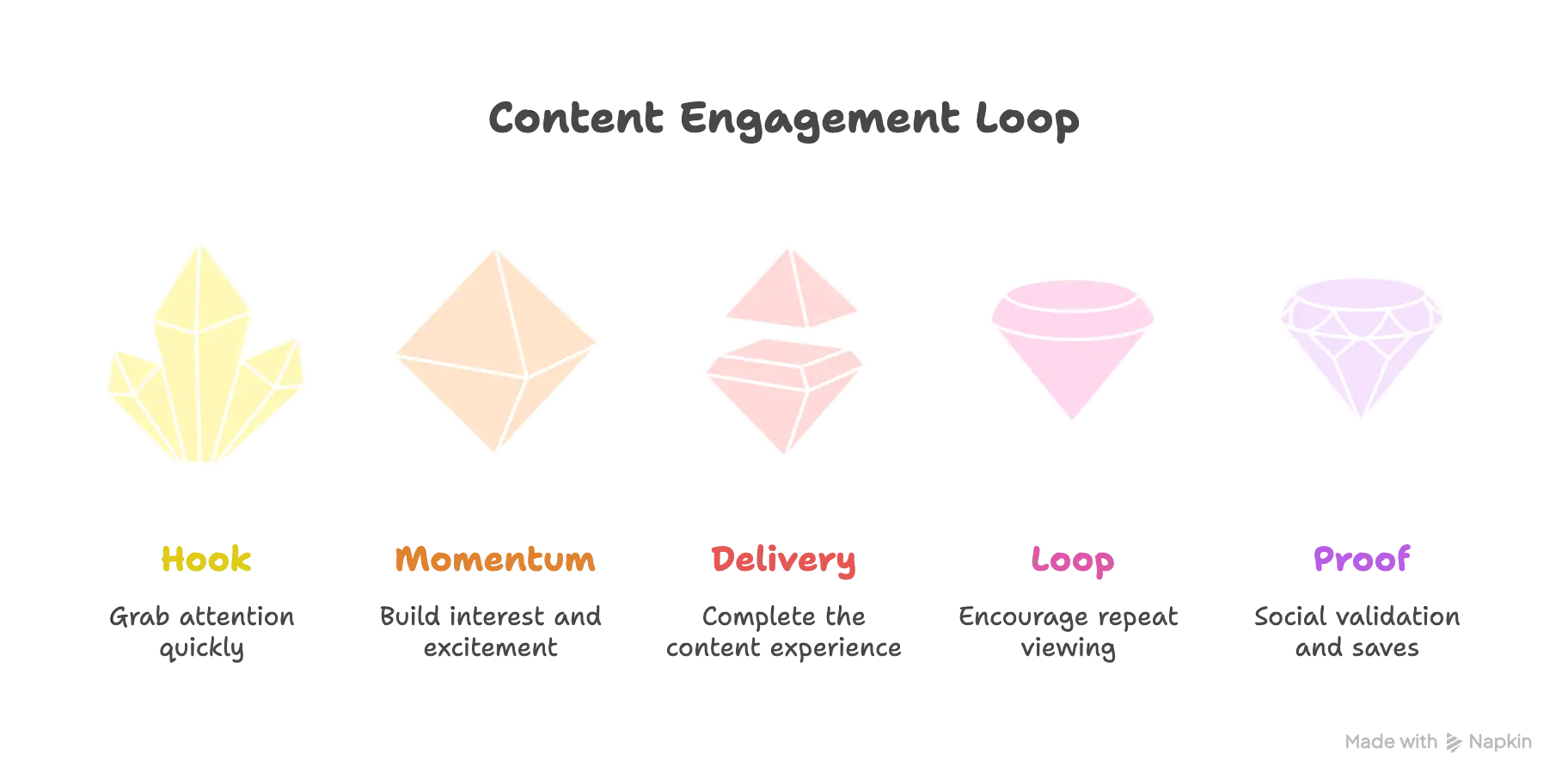
If early retention is strong, you get shown to more people. More testing leads to more distribution. More distribution gives you more chances to prove you can hold attention. That’s the loop. Higher early retention → more testing → more distribution.
And then the real accelerants kick in:
- Completion tells TikTok your video delivered.
- Rewatches tell TikTok your video had “wait—run that back” energy.
Both amplify reach because they scream this wasn’t just watched, it was consumed.
5.2 The real goal: sustaining retention, not just getting the view
A 3-second view is a foot in the door. Retention is what gets you invited back.
TikTok watches for:
- Completion rate (do people finish?)
- Replay rate (do they rewatch?)
- Deeper engagement (saves, shares, meaningful comments—not just likes)
- Niche relevance (does this match what a specific audience repeatedly watches?)
If your hook is good but the middle is mush, people leave at 6–12 seconds. That’s the common failure. You won the click. You lost the watch.
6) How to Hold Attention Past 15–20 Seconds (2025 Retention Strategy)
6.1 Build “micro-hooks” into the body
In 2025, you don’t hook once. You re-hook repeatedly.
A simple rule: drop a new reason to stay every 3–5 seconds—a new visual, a new detail, a mini-reveal, a sharper promise, a twist, a “next step.”
Micro-hooks can be:
- “wait for step 3—this is where people mess up”
- a quick cut + new angle
- a surprising example
- a short “before/after” flash mid-video
- a countdown (“3…2…1…”) that forces pacing
6.2 Simple structures that keep people watching
These formats do the retention work for you:
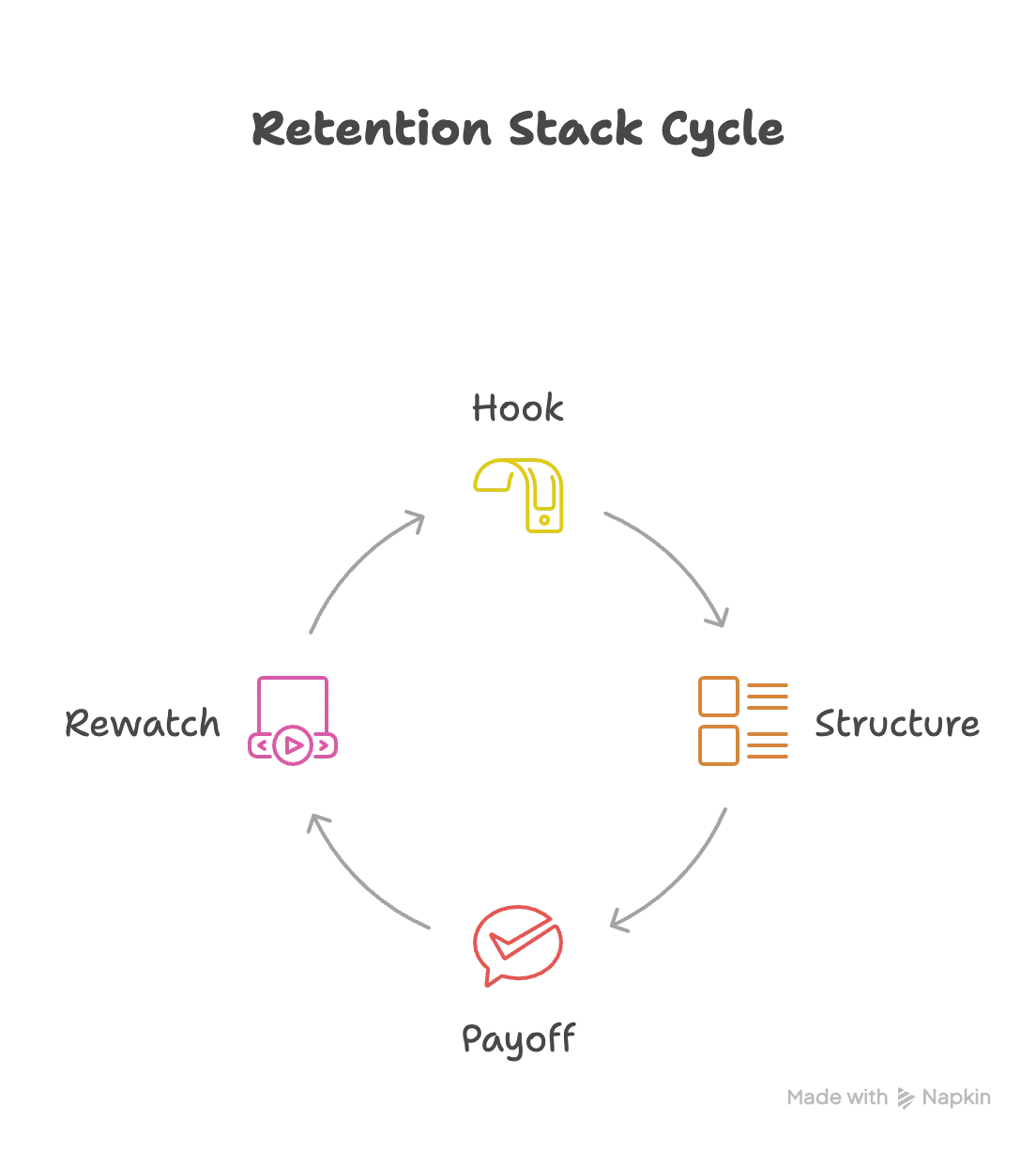
- Open loop → steps → payoff
Tease the outcome, then earn it in tight steps, then deliver clearly. - “3 mistakes / 3 tips” list format
Built-in momentum. People stay because they want the next number. - Before/after + “how I did it”
Show result, then give the method with quick proof points. - Escalation structure (each beat raises stakes)
Each segment gets more specific, more surprising, or more valuable than the last.
6.3 Engagement depth signals that matter more than likes
Likes are easy. Depth is rare. TikTok values the stuff that signals real interest:
- Saves: “i need this later”
- Shares: “someone else needs this”
- Comments: “i’m involved”
To drive them intentionally:
- Ask for a save when you give a checklist, template, or steps (“save this for next time”).
- Make sharing the obvious move (“send this to the friend who always does X”).
- Prompt specific comments (“which one are you: A, B, or C?” / “drop your niche and i’ll tailor part 2”).
7) Common Mistakes That Kill Retention
Slow intros / context dumps
If your first line is “so today i’m gonna…” you’ve already lost. TikTok isn’t a meeting. It’s a hallway. Start with the point, not the preface.
Only relying on text overlays (no visual momentum)
Text can help. Text can’t carry. If the visuals don’t move, change, or progress, viewers feel the drag—even if the words are good. Give the eye something to follow: cuts, close-ups, gestures, on-screen action, pattern breaks.
Treating 3 seconds like the finish line (ignoring 15–20s+)
A strong hook with a flat middle is the classic retention cliff. The video “wins” the view and then bleeds attention. In 2025, you need a second and third reason to stay—especially around that 15–20 second window.
Weak sound strategy (TikTok is sound-on; audio matters)
Muffled voice, random music, no rhythm, dead air—these are invisible exit signs. Audio isn’t decoration. It’s pacing. It’s emotion. It’s clarity. Clean voice, intentional music, and purposeful beats matter.
Skipping captions/hashtags (distribution + categorization help)
Captions and hashtags aren’t magic. But they do help TikTok understand what your video is about and who it should show it to. If you skip them, you make the algorithm guess—and guessing is rarely generous.
8) Does the 3-Second Rule Apply Outside TikTok?
8.1 Cross-platform translation
Yes. The principle travels well because the behavior is the same: thumb on screen, attention on a hair trigger. Instagram Reels and YouTube Shorts also reward immediate attention in the first 2–3 seconds.
8.2 Platform nuance (how to adapt)
What stays the same
- Hook speed: earn attention instantly.
- Payoff clarity: make the value obvious early.
- Retention mindset: don’t just start strong—keep re-earning attention.
What changes
- Pacing: Shorts often tolerates slightly cleaner, more linear delivery; Reels can lean more aesthetic and trend-forward (depending on niche).
- Metadata: what you write (caption/keywords/hashtags) and how it’s interpreted differs by platform.
- Audience expectation: Reels viewers may expect more polish; TikTok viewers often reward raw clarity; Shorts audiences can skew more search-intent when topics are “how-to.”
Same rule, different room. Adjust the volume—keep the message.
9) Measurement + Optimization (Make It Repeatable)
9.1 The metrics to watch (mapped to checkpoints)
0s → 3s: 3s hold rate
- are people staying long enough to “qualify” as a real watch?
- if this is weak, your hook/frame/premise isn’t landing.
3s → 15–20s: 15–20s retention
- do people keep watching once the curiosity spike fades?
- this is where “great hook, boring middle” dies.
End of video: completion rate
- how many viewers finish?
- completion is a loud signal that the video delivered.
Across the whole video: replay rate
- are people looping it, rewatching key parts, or watching twice?
- replays often mean “dense value” or “clean twist.”
Depth signals: saves / shares / comments
- saves = “useful, i need this later”
- shares = “this is so good i’m sending it”
- comments = “i’m involved”
These tend to matter more than simple likes when you’re trying to scale distribution.
9.2 Quick testing loop (creator workflow)
Make 3 hook variants → post/test → double down on winners
- same topic, same video body, different first 1–2 lines / first frame
- test fast, learn fast, repeat.
Iteration checklist (what to tweak first):
- Hook: first frame + first sentence + on-screen promise
- Pacing: cut dead air, shorten steps, add micro-hooks
- Visuals: tighter framing, more motion, clearer on-screen text, pattern breaks
- Audio: clean voice, purposeful music/beat changes, no muddy sound
- Payoff: deliver earlier, make the “why it matters” obvious, end clean (loopable)
10) Bottom Line (Conclusion)
The 3-second rule is the entry ticket. If you don’t win the first three seconds, nothing else matters—because nobody sticks around long enough to see your good part.
But 2025 success is entry ticket + retention checkpoints. You’re not just trying to stop the scroll. You’re trying to keep earning attention at 15–20 seconds, push toward completion, and trigger saves, shares, and rewatches.
Final CTA: Master the hook + structure the whole video for re-hooks.
FAQ
Is the 3-second rule still relevant in 2025?
Yes — it’s still the first gate. TikTok (and TikTok’s own best-practice guidance for creatives) repeatedly emphasizes that the opening seconds are where you win attention, set context, and prevent the swipe.
What did change is that 2025 performance is less “hook once and chill” and more “hook early, then keep earning attention,” especially around the 15–20 second retention point.
Does TikTok count a view at 3 seconds or instantly?
For organic TikTok videos, many creator-focused guides describe a view being counted once someone watches at least ~3 seconds.
Even if TikTok’s exact counting rules vary by surface or evolve over time, the practical takeaway doesn’t change: your first 3 seconds are a measurable retention checkpoint, and early drop-offs tend to hurt distribution.
What’s more important: likes or watch time?
Watch time and retention. Likes are easy. Staying is rare.
TikTok’s ranking signals include likes/comments/shares, but the strongest indicator of “this deserves more reach” is typically how long people watch (and whether they finish or rewatch).
A simple way to think about it:
- likes = “i approve”
- watch time = “i couldn’t look away”
How do I improve retention after 15–20 seconds?
Treat 15–20 seconds like a second hook, not “the middle.”
Some analyses of recent algorithm behavior point to the 15–20s retention mark as a quality indicator: videos that keep viewers past that point tend to get stronger distribution.
What to do in practice:
- add a micro-hook every 3–5 seconds (new visual, new detail, mini-reveal, escalating stakes)
- keep structure obvious (open loop → steps → payoff)
- deliver proof early (show the result, then explain)
- cut anything that feels like “setup” once the viewer is already in
Do hashtags and captions still matter?
Yes — not as magic dust, but as categorization and discovery tools.
TikTok algorithm explainers consistently list captions/hashtags/sounds as “video information” used to help categorize and recommend content, and TikTok’s own guidance has long recommended using relevant hashtags so the right audience can find your video.
Rule of thumb:
- use a small set of relevant hashtags (topic + niche), not a hashtag dump